
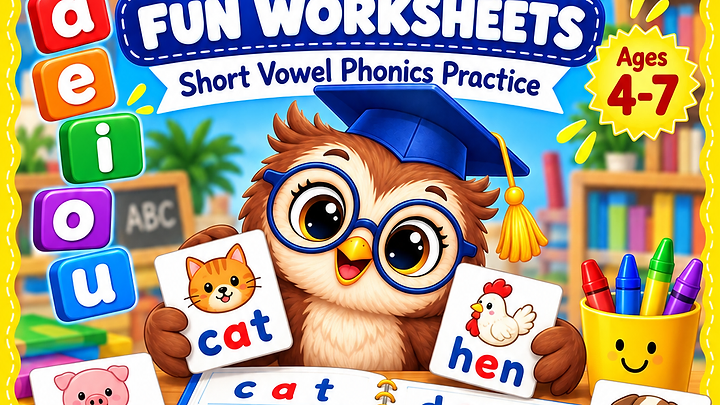
If your child knows their letter sounds, the next big step is reading real words. For most children, those first words are CVC words.
What does CVC stand for?
CVC stands for consonant – vowel – consonant. A CVC word has three letters: a consonant, a short vowel in the middle, then another consonant.
Examples: cat, pig, sun, bed, hop.
Every letter makes its most common sound, so children can read the word by saying each sound and blending them together: c – a – t → cat.
Why CVC words matter
- They're decodable. Children can work them out on their own instead of guessing.
- They teach blending, the core skill behind all reading.
- They build confidence. Reading a whole word by yourself is a huge moment for a four- or five-year-old.
- They lead straight into longer words. Once cat is easy, cats, catch and catnap aren't far away.
When is my child ready?
Most children start CVC words in the pre-K or kindergarten years, usually around ages 4 to 6. A good sign of readiness is that your child can tell you the sound (not just the name) of most letters. If letter sounds are still shaky, spend a little more time there first — our free Alphabet Adventure game is a fun way to practise.
CVC word lists by short vowel
Practise one vowel at a time before mixing them up.
- Short a: cat, bat, hat, map, pan, bag, dad, ham, jam, van
- Short e: bed, red, hen, pen, ten, jet, net, leg, web, wet
- Short i: pig, big, dig, sit, pin, lip, hid, zip, fin, wig
- Short o: dog, hop, pot, top, fox, box, log, mop, hot, cot
- Short u: sun, bus, cup, bug, hug, mud, run, tub, nut, pup
How to teach CVC words at home
1. Tap and blend
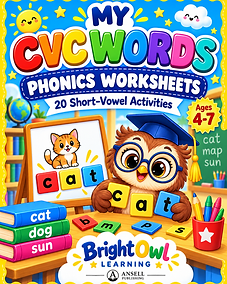
Write a word, then have your child touch a finger for each sound: c – a – t. Then sweep a finger under the word and blend the sounds smoothly: cat. Our CVC Words Phonics Worksheets are built around this tap-and-blend routine.
2. Stretch it like a slinky
Say the word slowly, stretching the sounds (sssuuunnn), then snap it back together (sun). Children love the silliness, and it trains their ear to hear each sound.
3. Change one letter
Make cat with letter magnets, then swap the first letter to make hat, bat, mat. Then change the vowel: cat → cut → cot. This shows children that every letter matters.
4. Read in word families
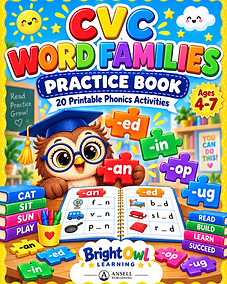
Grouping words that end the same way (like -at or -ug) helps children read lots of new words quickly. Learn more in our guide to word families.
5. Keep it short and playful
Five to ten minutes a day beats one long session a week. Stop while it's still fun.
Common stumbling blocks
- Adding an 'uh' sound: saying buh-a-tuh for bat. Model short, crisp sounds.
- Mixing up short e and short i: these sound similar. Practise pen/pin and bed/bid side by side.
- Reading the first letter and guessing: gently point back to each letter and blend again.
Ready-to-print CVC practice
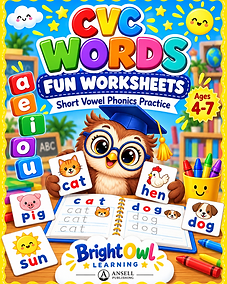
If you'd like done-for-you pages, the CVC Words Worksheets for Kindergarten pack covers all five short vowels with cut-and-paste, word searches and scrambles, and the CVC Word Families mini-books give early readers real little books to read on their own.
For free, screen-based practice, try the Missing letter level of Sound Safari in our ad-free Kids Zone.