
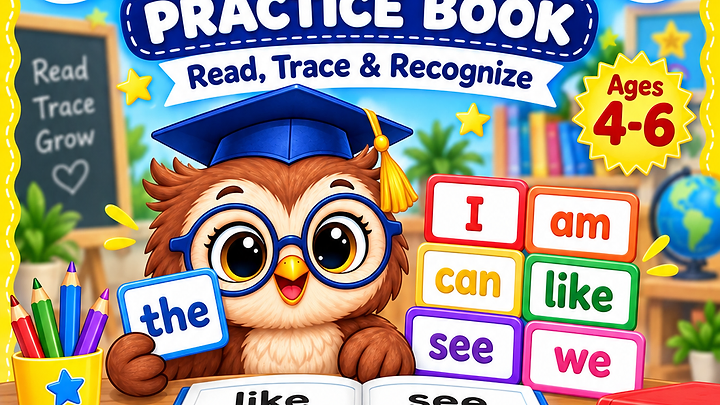
Open any children's book and you'll see the same small words again and again: the, and, is, to, you. These are sight words (also called high-frequency words), and learning them helps children read more smoothly and with more confidence.
What are sight words?
Sight words are the most common words in written English. Some can be sounded out (it, can), while others don't follow the usual rules (said, was, the). Either way, the goal is for children to recognise them quickly and automatically, so they can put their energy into the harder words in a sentence.
A first sight word list
Start small. These are great first words for pre-K and kindergarten:
a, I, the, and, see, can, go, to, is, it, in, my, we, me, up, look, here, you
Once those are solid, move on to words like he, she, was, for, on, are, said, have, like, they, this, that, with, come, play.
7 fun ways to teach sight words
1. See it, say it, spell it, say it again
Show the word, read it together, spell it out loud letter by letter, then read it again. This quick routine connects the look, sound and spelling of the word.
2. Trace and write
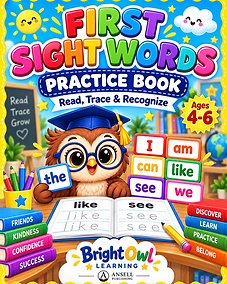
Tracing a word with a finger, then a crayon, then a pencil helps it stick. Our First Sight Words Worksheets combine tracing, reading and cut-and-paste sentences for each word.
3. Build sentences
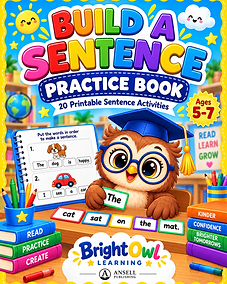
Sight words only really make sense inside sentences. Cut up a simple sentence (I can see a cat.) and let your child put it back in order. The Build a Sentence Worksheets give 80 scrambled sentences with picture clues.
4. Word hunts
Pick one word of the day and hunt for it in picture books, cereal boxes and street signs. Every time your child finds it, celebrate!
5. Play listening games
Say a word and have your child find it among three or four cards. Our free Sight Word Stars game does exactly this — it reads a word aloud and your child taps the right one, with three levels of word lists.
6. Get moving
Tape words to the floor and call one out for your child to jump on. Movement makes practice feel like a game and helps busy learners focus.
7. Review little and often
New words fade quickly if they aren't practised. Keep a small stack of 'known' words and flip through them for a minute each day, adding one or two new words at a time.
How many sight words should my child know?
It varies by school and by child, so there's no single right number. Focus on steady progress rather than a target: a few new words each week, with plenty of review, adds up quickly.
Sight words and phonics work together
Sight words don't replace phonics — they sit alongside it. Keep practising letter sounds and CVC words so your child can decode new words, while sight word practice builds speed on the most common ones.
Ready to practise?
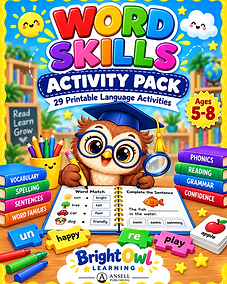
The First Sight Words Worksheets are a gentle start for ages 4–6, and the Word Skills Activity Pack mixes sight words with phonics, vocabulary and reading comprehension for kindergarten to grade 2.